
United Kennel Club breed · Source-checked care guide
American Bulldog.
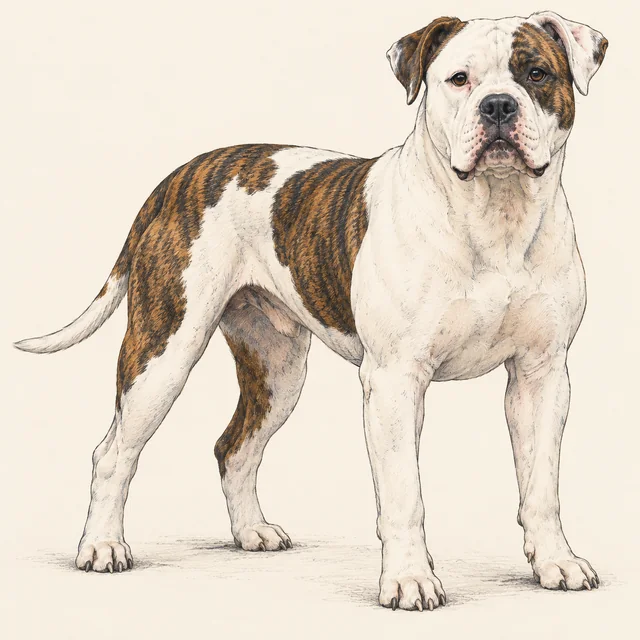
The American Bulldog's farm-dog story reaches from England's working Bulldogs to the American South. The United Kennel Club describes distinct lines shaped by different jobs, alongside a powerful, muscular outline. Admirers may value that working identity; the actual dog's family background and experience give the more useful personal portrait.
Editorial opening portrait · checked . Admirer appeal is editorial; individual dogs vary.
Opening portrait sources (1)
- United Kennel Club: American Bulldog ↗ · Registry appearance standard · US registry standard and historical account · checked .
History and appearance follow the linked accounts, which may retain uncertain origins or traditional stories. Admirer appeal is not an owner survey, and this portrait supplies no matching inputs.
Care sources checked · See the evidence
Related guides
Care at a glance
Publisher care guidance to explore, not a prediction about an individual dog.
Lifespan entries retain the source’s category or guide range; they are not comparable clinical survival estimates. Exercise guides are not personal prescriptions.
Beyond the facts
A little more of the story.
The American Bulldog's history belongs to farms and working households. The United Kennel Club traces its ancestry to Bulldogs used in England for cattle work and property guarding, then preserved by immigrants in the American South. Its account describes small farmers and ranchers relying on a versatile working dog. The American Kennel Club's modern overview also emphasises that farm-utility background, alongside strength, endurance and agility.
The UKC tells a revival story after the Second World War, when John D. Johnson helped rebuild a population it describes as almost lost. Johnson, Alan Scott and other breeders developed different working lines; the UKC distinguishes the heavier Johnson type from the more athletic Scott type and notes dogs combining lines. That variety matters when looking at an actual dog. The name does not settle its build, and the breed's historical purpose cannot tell you how an individual will behave at home.
A contemporary rescue perspective adds another part of the picture. Dogs Trust describes American Bulldogs as large, muscular dogs with short coats, and puts daily walks, play, exploration and enrichment into its care guidance. The charity repeatedly asks readers to consider the individual's age, health and personality. It is a useful counterweight to an account concerned mainly with ancestry and the ideal working dog.
The appeal, for an admirer, may be that combination of a substantial, athletic outline and a practical farm-dog story. Turn that appeal into a conversation about the individual: how does it walk on a lead, settle indoors, respond to visitors and enjoy being handled? Ask its present carer to describe ordinary routines and any support already in place. A convincing history is a reason to take interest, not a guarantee of an easy household match.
Editorial portrait drawing on the sources below. History and appearance do not predict an individual dog’s character.
- United Kennel Club: American Bulldog history, types and standard ↗ · also listed under “Opening portrait sources” above · checked .
- American Kennel Club: American Bulldog farm-utility overview ↗ · Registry breed overview · US registry breed overview; not measured individual behaviour · checked .
- Dogs Trust: American Bulldog care and individual assessment ↗ · Charity guidance · UK rehoming charity guidance; individual needs vary · checked .
Where you may encounter them
Country context.
United Kingdom: a comparable 2025 registration count is not established here.
United States: no directly matched 2025 AKC ranking is established for this profile.
These are two different registry measures, not counts of all dogs or a global popularity comparison. Other countries and current local availability are unknown here. Registration frequency does not affect matching.
Why explore this option
Potential advantages
- Weekly coat care in the publisher’s guide.Editorial consideration · Coat careAmerican Bulldog source ↗
The everyday reality
Commitments to consider
- Individuals vary; the publisher’s guide is general, so meet the actual dog and ask about its parents’ temperaments.Editorial considerationAmerican Bulldog source ↗
- Plan for adult size, including space, transport, feeding and veterinary costs.Editorial consideration · SizeAmerican Bulldog source ↗
- Account for shedding.Editorial consideration · SheddingAmerican Bulldog source ↗
- The publisher’s guide is conflicting, mixed or not a single value for activity needs; treat these as unknown and ask about the individual dog.Editorial considerationAmerican Bulldog source ↗
Meet the individual
Questions worth asking.
Editorial prompts for a rescue, breeder or professional. Asking a question does not establish a trait or confirm that screening has happened.
- How big were this dog’s parents, and how did they behave around strangers and other dogs?
- What activity does this individual need, and what is their history around other dogs and being left alone?
- Which health checks have been completed for the parents?
For a home with children or another dog, discuss observed behaviour, gradual introductions, supervision and separate spaces. Breed alone cannot establish a safe match.
Visible health concerns: RKC Breed Watch
No category stated. We did not find a Breed Watch category for this breed on the Royal Kennel Club pages we read, so we treat it as unknown, not as a good sign.
Breed Watch is the Royal Kennel Club’s system for health concerns it links to a breed’s shape, mainly ones that can be seen in the show ring. It says nothing about inherited disease or how many dogs are affected, and a category describes a breed, not an individual dog. It does not change how breeds are matched here. Source: Royal Kennel Club — Breed Watch: health and welfare of show dogs ↗, checked 3 October 2026.
Inherited health, screening and allergies
What should you ask about before falling in love with this dog? Published pre-breeding checks are a starting point: some test for inherited conditions, others assess hips, eyes, breathing or other concerns. Results are not a guarantee, and this is not a complete disease list.
Purina highlights breathing obstruction, skin-fold problems, eye ulcers and hip and elbow dysplasia. Discuss these concerns and the individual dog’s shape and history with your vet.
This publisher context is not a comparable registry screening checklist or a measured risk estimate. A cross cannot be assumed to inherit an average of its parents’ risks, or to be healthier because it is a cross.
Source: Purina UK breed context ↗ · United Kingdom · checked . Registry recommendations can change; ask for original results and their interpretation for the actual dog and, where relevant, its parents.
Clinical risk estimates for this profile have not yet been reviewed; discuss this dog’s history and screening with a vet, rescue or responsible breeder. UK health and screening resources ↗
No dog is 100% hypoallergenic. Coat and shedding information cannot guarantee that an allergic person will tolerate a dog. AAAAI allergy guidance ↗
Could an American Bulldog fit your life?
Check the American Bulldog against your own weekday routine, home and coat-care time. Your answers stay on your device.
UK · reference floor, not a quote · checked 17 October 2026
What American Bulldog care might cost.
These are UK charity estimates for a dog of a similar size, not prices for American Bulldog specifically. Our “large” category is shown against PDSA’s large-breed estimate.
- Getting started (minimum)
- £560
- Each month (minimum)
- £116
- Each year (our arithmetic: monthly × 12)
- £1,392
- PDSA size-band lifetime minimum
- £8,200 to £18,800
The lifetime estimate uses PDSA’s size-group life-expectancy assumptions, not this breed’s recorded lifespan.
Source: PDSA, the cost of owning a dog ↗. Minimum costs, calculated in 2024 from online product prices; the page shows no update date and does not define its size bands. Excludes the dog’s price, microchipping and vet fees for illness or injury. Because PDSA does not define its size bands, any match between a breed and a band is editorial.
A second view. Battersea says it typically costs £1,800 to £2,000 a year to care for a dog, which is higher than the minimum above. Battersea gives no size or breed breakdown for that figure, so the difference may reflect different assumptions; neither source is a quote. Battersea source ↗
What is not here. The price or adoption fee, vet bills for illness or injury, insurance premiums for this breed, training, boarding and breed-specific health costs. We have no source for a breed-specific cost, so none is given. How the figures compare →
Open the field notes
Sources & limitations
Each care entry retains its publisher’s meaning. Open a note to see what was checked and what it cannot tell you. A note with no publication or data date line has none established for that guidance. Checked dates are not study dates.
These points apply to several notes and sources below:
- Individuals can differ from these guides; meet the actual dog.
SizePublished guidance
Large (Dogs Trust)
- Measure
- Publisher size category
- Source context
- UK animal-welfare charity breed guidance (non-commercial) · United Kingdom
- Checked
Dogs Trust lists size as “Large”. The United Kennel Club standard (updated September 12, 2023) gives desirable height of 22 to 27 inches for mature males and 20 to 25 inches for mature females, with weight only “in proportion to height”. VetCompass (O’Neill et al., PLoS ONE 2023) records a median adult bodyweight of 37.5 kg (females 35.0, males 40.0) for dogs labelled American Bulldog.
Read the original size source ↗ActivityAmount unknown
Typically moderately active; needs regular exercise and stimulation (Dogs Trust); no hours given
- Measure
- Publisher daily activity guide
- Source context
- UK animal-welfare charity breed guidance (non-commercial) · United Kingdom
- Checked
Dogs Trust says American Bulldogs are “typically moderately active dogs” who “need regular exercise and stimulation to keep them physically and mentally healthy”. It gives no hours, so no activity band is encoded.
Read the original activity source ↗Coat carePublished guidance
An occasional brush; skinfolds often need regular cleaning (Dogs Trust)
- Measure
- Publisher coat-care frequency
- Source context
- UK animal-welfare charity breed guidance (non-commercial) · United Kingdom
- Checked
Dogs Trust says “American Bulldogs have short fur that generally only needs an occasional brush. American Bulldogs often have skinfolds which require regular cleaning.” Band 1 (the least frequent band) is our editorial mapping of “occasional”. Skinfold cleaning is a separate commitment that the band does not capture; the page advises asking your vet how to do it.
Read the original coat care source ↗SheddingPublished guidance
Moderate shedding, short coat (Dogs Trust)
- Measure
- Publisher shedding category
- Source context
- UK animal-welfare charity breed guidance (non-commercial) · United Kingdom
- Checked
Dogs Trust lists “Short length with moderate shedding”. This replaces the Purina UK wording for the same value (sheds). A category, not a measured amount; not an allergy statement.
Read the original shedding source ↗Lifespan guidancePublished guidance
10+ years (Dogs Trust guidance)
- Measure
- Publisher lifespan guidance
- Source context
- UK animal-welfare charity breed guidance (non-commercial) · United Kingdom
- Checked
Dogs Trust says “typically 10+ years”; this is guidance, not a survival estimate. The earlier Purina UK 10–12 years is removed because no non-commercial source supports that range; it is guidance and is not directly comparable with a life-table life expectancy at birth. Separately, Teng et al. (Scientific Reports, published 28 April 2022, Table 3) report a UK life expectancy at age 0 of 7.79 years (95% CI 7.16–8.33) for 129 American Bulldogs. They were among 30,563 dogs that died between 1 January 2016 and 31 July 2020 in the VetCompass UK primary-care population (overall 11.23 years, 95% CI 11.19–11.27). That is a measured mortality outcome from a hypothetical-cohort life table, a different measure from guidance: shifts in breed popularity bias it, and frequent euthanasia, including for non-life-threatening reasons, can shorten it. It is not a prediction for an individual dog and is not substituted for the guidance.
Read the original lifespan guidance source ↗- Purina UK — American Bulldog ↗Pet-food manufacturer’s breed guide (commercial editorial) · United Kingdom · Checked 2026-10-03
A pet-food manufacturer’s breed guide, not a clinical study or a registry standard. Each page’s summary list and body text can disagree; the body text is used, and a fact is recorded as unknown where they conflict materially. An individual dog can differ from the guide; where the page says a trait is hard to predict or gives no usable statement it is recorded as unknown. The page’s star ratings and family-suitability statements are not adopted, and no health, safety or allergy assurances are taken from it. On 13 October 2026 these fields were replaced or relabelled using non-commercial sources where those conflicted with or covered this page: size, exercise, grooming, shedding, lifespan. Any field not listed stays on this single commercial page unless stated. - Dogs Trust — American Bulldog ↗UK animal-welfare charity breed guidance (non-commercial) · United Kingdom · Checked 2026-10-13
Broad charity guidance, not a measured distribution of individual dogs. Categories may differ between publishers; no clinical or compatibility estimate is implied. No publication or update date is shown on the page.
Editorial advantages and commitments interpret these facts; they are not compatibility probabilities. The source tables and editorial mapping were independently checked by another AI agent; this is not veterinary or expert review. Read our method