
Gundog · Source-checked care guide
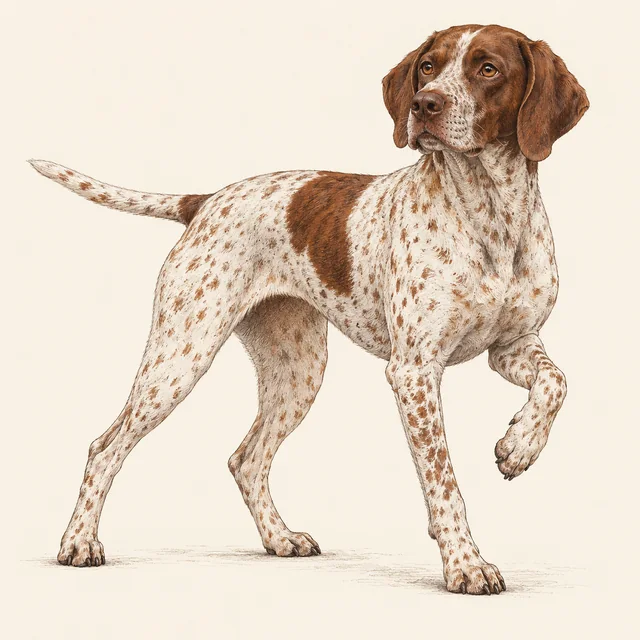
Braque du Bourbonnais.
The Braque du Bourbonnais belongs to an old French pointing tradition, named for its home region. It declined when breeding fashion displaced working priorities, then benefited from dedicated revival efforts. Admirers are drawn to that combination of regional heritage and survival: a sporting dog preserved for the useful qualities that originally gave it a place beside people.
Editorial opening portrait · checked . Admirer appeal is editorial; individual dogs vary.
Opening portrait sources (1)
- Royal Kennel Club — Braque du Bourbonnais ↗ · Registry history · UK registry account · checked .
History and appearance follow the linked accounts, which may retain uncertain origins or traditional stories. Admirer appeal is not an owner survey, and this portrait supplies no matching inputs.
Care sources checked · See the evidence
Care at a glance
Publisher care guidance to explore, not a prediction about an individual dog.
Lifespan entries retain the source’s category or guide range; they are not comparable clinical survival estimates. Exercise guides are not personal prescriptions.
Beyond the facts
A little more of the story.
The Braque du Bourbonnais is one of the oldest French pointing breeds, named after the old province of Bourbonnais in central France. "Braque" comes from a French word for aiming or pointing. The breed was already described in 1598, as a pleasant, hardy companion for hunters that would find, point and retrieve game over varied ground.
Its modern story is one of near loss through fussiness over looks. After the First World War, enthusiasts founded a breed club in 1925 and published a standard in 1930, but they insisted on a faded lilac coat colour and a tail that was naturally short from birth. This narrow selection, together with the Second World War, pushed the breed close to the edge, and accounts say no puppies were registered between 1963 and 1973. A team of breeders took up its cause in the 1970s, a new club was formed in 1982 by Michel Comte, the standard was relaxed to accept spots and docked tails, and an updated standard was recognised in 1991.
Today's Bourbonnais is white with fine brown or fawn ticking and is expected to work well as a pointer, retriever and tracker. Admirers value its kindness at home and close bond with its family. It is a working gundog that needs regular exercise, training and mental stimulation, which makes it best suited to active owners.
Editorial portrait drawing on the sources below. History and appearance do not predict an individual dog’s character.
- Royal Kennel Club breed history ↗ · also listed under “Opening portrait sources” above · checked .
- American Kennel Club breed history ↗ · Registry history · US registry account of breed origins · checked .
- FCI breed standard: historical summary ↗ · Registry appearance standard · International standard (FCI), historical summary · checked .
Where you may encounter them
Country context.
United Kingdom: a comparable 2025 registration count is not established here.
United States: no directly matched 2025 AKC ranking is established for this profile.
These are two different registry measures, not counts of all dogs or a global popularity comparison. Other countries and current local availability are unknown here. Registration frequency does not affect matching.
Why explore this option
Potential advantages
- Weekly coat care in the registry guide.Editorial consideration · Coat careBraque du Bourbonnais source ↗
The everyday reality
Commitments to consider
- Plan for activity in the registry’s middle band, with enrichment on top.Editorial consideration · ActivityBraque du Bourbonnais source ↗
- Account for shedding.Editorial consideration · SheddingBraque du Bourbonnais source ↗
- Plan for adult size, including space, transport, feeding and veterinary costs.Editorial consideration · SizeBraque du Bourbonnais source ↗
Meet the individual
Questions worth asking.
Editorial prompts for a rescue, breeder or professional. Asking a question does not establish a trait or confirm that screening has happened.
- How much activity does this individual need, and how have they been given it so far?
- What is this dog’s history around other dogs, other animals and being left alone?
- Which breed-relevant health checks have been completed for the dog or its parents?
For a home with children or another dog, discuss observed behaviour, gradual introductions, supervision and separate spaces. Breed alone cannot establish a safe match.
Visible health concerns: RKC Breed Watch
No category stated. We did not find a Breed Watch category for this breed on the Royal Kennel Club pages we read, so we treat it as unknown, not as a good sign.
Breed Watch is the Royal Kennel Club’s system for health concerns it links to a breed’s shape, mainly ones that can be seen in the show ring. It says nothing about inherited disease or how many dogs are affected, and a category describes a breed, not an individual dog. It does not change how breeds are matched here. Source: Royal Kennel Club — Breed Watch: health and welfare of show dogs ↗, checked 3 October 2026.
Inherited health, screening and allergies
What should you ask about before falling in love with this dog? Published pre-breeding checks are a starting point: some test for inherited conditions, others assess hips, eyes, breathing or other concerns. Results are not a guarantee, and this is not a complete disease list.
No named current screening tests were recorded from this breed’s RKC page in this review. This does not establish low risk; ask the breed club and your vet about current recommendations.
The RKC also highlights preserving genetic diversity when planning breeding.
Source: RKC breed health guidance ↗ · United Kingdom · checked . Registry recommendations can change; ask for original results and their interpretation for the actual dog and, where relevant, its parents.
Clinical risk estimates for this profile have not yet been reviewed; discuss this dog’s history and screening with a vet, rescue or responsible breeder. UK health and screening resources ↗
No dog is 100% hypoallergenic. Coat and shedding information cannot guarantee that an allergic person will tolerate a dog. AAAAI allergy guidance ↗
Could a Braque du Bourbonnais fit your life?
Check the Braque du Bourbonnais against your own weekday routine, home and coat-care time. Your answers stay on your device.
Check Braque du Bourbonnais in Your Doggy Match →
Compare side by side with Brittany and Chesapeake Bay Retriever →
Other gundog breeds
From the same breed group, in alphabetical order; not a ranking or recommendation.
UK · reference floor, not a quote · checked 17 October 2026
What Braque du Bourbonnais care might cost.
These are UK charity estimates for a dog of a similar size, not prices for Braque du Bourbonnais specifically. Our “medium to large” category spans PDSA’s medium and large estimates.
- Getting started (minimum)
- £531 to £560
- Each month (minimum)
- £83 to £116
- Each year (our arithmetic: monthly × 12)
- £996 to £1,392
- PDSA size-band lifetime minimum
- £8,200 to £18,800
The lifetime estimate uses PDSA’s size-group life-expectancy assumptions, not this breed’s recorded lifespan.
Source: PDSA, the cost of owning a dog ↗. Minimum costs, calculated in 2024 from online product prices; the page shows no update date and does not define its size bands. Excludes the dog’s price, microchipping and vet fees for illness or injury. Because PDSA does not define its size bands, any match between a breed and a band is editorial.
A second view. Battersea says it typically costs £1,800 to £2,000 a year to care for a dog, which is higher than the minimum above. Battersea gives no size or breed breakdown for that figure, so the difference may reflect different assumptions; neither source is a quote. Battersea source ↗
What is not here. The price or adoption fee, vet bills for illness or injury, insurance premiums for this breed, training, boarding and breed-specific health costs. We have no source for a breed-specific cost, so none is given. How the figures compare →
Open the field notes
Sources & limitations
Each care entry retains its publisher’s meaning. Open a note to see what was checked and what it cannot tell you. A note with no publication or data date line has none established for that guidance. Checked dates are not study dates.
SizePublished guidance
Medium–large (registry category)
- Measure
- Publisher size category
- Source context
- Registry lifestyle guidance · United Kingdom
- Checked
A broad classification, not an exact adult weight, height or space requirement.
Read the original size source ↗ActivityPublished guidance
1–2 hours/day (registry guide)
- Measure
- Publisher daily activity guide
- Source context
- Registry lifestyle guidance · United Kingdom
- Checked
Not an individual exercise prescription. An “up to” category establishes no minimum; age, health and enrichment need a separate assessment.
Read the original activity source ↗Coat carePublished guidance
Weekly coat care (registry guide)
- Measure
- Publisher coat-care frequency
- Source context
- Registry lifestyle guidance · United Kingdom
- Checked
A broad routine guide, not a complete schedule of brushing, trimming, bathing or professional care.
Read the original coat care source ↗SheddingPublished guidance
Sheds
- Measure
- Publisher shedding category
- Source context
- Registry lifestyle guidance · United Kingdom
- Checked
Not a measured amount of hair and not evidence of human allergy tolerance. Unknown or variable shedding receives no favourable score.
Read the original shedding source ↗Lifespan guidancePublished guidance
Over 12 years (registry category)
- Measure
- Publisher lifespan guidance
- Source context
- Registry lifestyle guidance · United Kingdom
- Checked
Registry thresholds and editorial ranges are not comparable survival statistics. No study dates, sample or survival method are established here.
Read the original lifespan guidance source ↗- Royal Kennel Club — Braque du Bourbonnais ↗Registry lifestyle guidance · United Kingdom · Checked 2026-10-03
Broad publisher guidance, not a measured distribution of individual dogs. Categories may differ between publishers; no clinical or compatibility estimate is implied. The registry marks this entry “Imp” (an imported breed); the categories are its own and say nothing about how many dogs are in the UK or where to find a puppy.
Editorial advantages and commitments interpret these facts; they are not compatibility probabilities. The source tables and editorial mapping were independently checked by another AI agent; this is not veterinary or expert review. Read our method