Gundog · Source-checked care guide
English Cocker Spaniel.
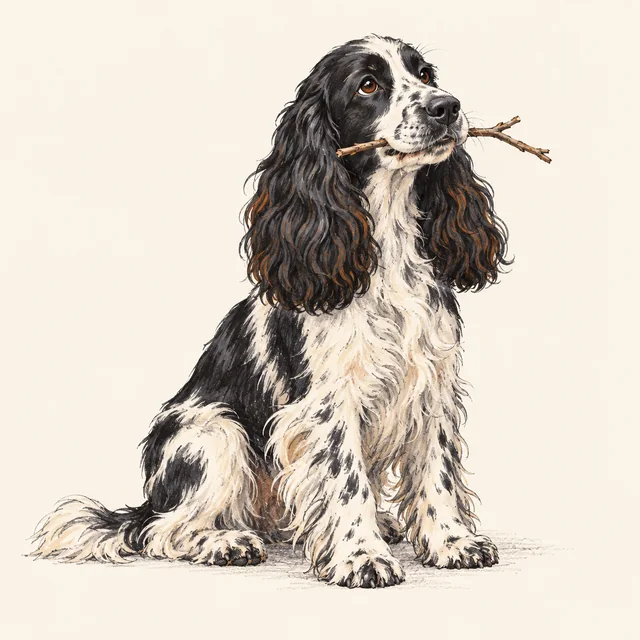
The English Cocker’s name recalls its original work with woodcock, while its wagging tail earned the familiar “merry cocker” description. Recognised separately in 1893, it developed from the wider land-spaniel family. Its appeal is a distinctly sporting warmth: a dog with a long companion history whose working and show lines still deserve individual understanding.
Editorial breed portrait · History and appearance from Royal Kennel Club ↗ · checked . Admirer appeal is editorial; individual dogs vary.
Care sources checked · See the evidence
Where you may encounter them
Country context.
United Kingdom: the RKC recorded 21,618 pedigree registrations for English Cocker Spaniel in 2025. See the UK history and source.
United States: English Cocker Spaniel ranked 35 in the AKC’s 2025 registration table. AKC table ↗ · checked 4 October 2026.
These are two different registry measures, not counts of all dogs or a global popularity comparison. Other countries and current local availability are unknown here. Registration frequency does not affect matching.
Lifespan entries retain the source’s category or guide range; they are not comparable clinical survival estimates. Exercise guides are not personal prescriptions.
Why explore this option
Potential advantages
- A smaller gundog option to explore.Editorial consideration · SizeCocker Spaniel source ↗
- Useful to compare with the Cockapoo and Miniature Poodle.Editorial considerationCocker Spaniel source ↗Cockapoo source ↗Miniature Poodle source ↗
The everyday reality
Commitments to consider
- Plan for daily coat care and shedding.Editorial consideration · Coat care / SheddingCocker Spaniel source ↗
- Ask about line and individual activity needs; a broad guide is not a personal exercise prescription.Editorial consideration · ActivityCocker Spaniel source ↗
Meet the individual
Questions worth asking.
Editorial prompts for a rescue, breeder or professional. Asking a question does not establish a trait or confirm that screening has happened.
- Is this a working or show line, and how does that affect daily life?
- What coat-care routine is needed?
- What relevant health results and history are available?
For a home with children or another dog, discuss observed behaviour, gradual introductions, supervision and separate spaces. Breed alone cannot establish a safe match.
How many are registered?
The Royal Kennel Club (RKC) recorded 21,618 English Cocker Spaniel registrations in 2025. This is a count of pedigree registrations, not of dogs in the UK, and not a measure of whether a puppy or adult dog is available near you.
| 2016 | 2017 | 2018 | 2019 | 2020 |
|---|---|---|---|---|
| 21,854 | 23,317 | 23,927 | 21,663 | 25,565 |
| 2021 | 2022 | 2023 | 2024 | 2025 |
|---|---|---|---|---|
| 38,910 | 29,491 | 26,239 | 23,177 | 21,618 |
Rarity and popularity play no part in how breeds are matched or ordered here, and neither says anything about health or suitability. Dashes mean the table gives no figure for that year (for example the breed was not yet listed). Source: Royal Kennel Club — Gundog registrations 2016–2025 ↗, checked 3 October 2026.
Visible health concerns: RKC Breed Watch
Category 1. The Royal Kennel Club describes category 1 as breeds with no visible health concerns linked to conformation, needing standard monitoring.
Breed Watch is the Royal Kennel Club’s system for health concerns it links to a breed’s shape, mainly ones that can be seen in the show ring. It says nothing about inherited disease or how many dogs are affected, and a category describes a breed, not an individual dog. It does not change how breeds are matched here. Ask about both parents’ health tests. Source: Royal Kennel Club — Breed Watch: health and welfare of show dogs ↗, checked 3 October 2026.
Inherited health, screening and allergies
What should you ask about before falling in love with this dog? Published pre-breeding checks provide a starting point: some test inherited conditions, while others assess hips, eyes, breathing or other health concerns. Results are not a guarantee, and this is not a complete disease list.
RKC Good Practice
RKC Best Practice
The RKC also highlights preserving genetic diversity when planning breeding.
Source: RKC breed health guidance ↗ · United Kingdom · checked . Registry recommendations can change; ask for original results and their interpretation for the actual dog and, where relevant, its parents.
Clinical risk estimates for this profile have not yet been reviewed. Ask about this dog’s history and relevant screening with a vet, rescue or responsible breeder. UK health and screening resources ↗
No dog is 100% hypoallergenic. Coat and shedding information cannot guarantee that an allergic person will tolerate a dog. AAAAI allergy guidance ↗
Costs and next steps
Acquisition and care prices for this breed have not been assessed here. Build a personal budget and explore both adoption and responsible buying.
Plan your next step →Open the field notes
Sources & limitations
Each care entry retains its publisher’s meaning. Open a note to see what was checked and what it cannot tell you.
SizePublished guidance
Small (registry category)
- Measure
- Publisher size category
- Source context
- Registry lifestyle guidance · United Kingdom
- Checked
- Publication / data dates
- Not established for this care guidance; the checked date is not a study date.
A broad classification, not an exact adult weight, height or space requirement.
Read the original size source ↗ActivityPublished guidance
Up to 1 hour/day (registry guide)
- Measure
- Publisher daily activity guide
- Source context
- Registry lifestyle guidance · United Kingdom
- Checked
- Publication / data dates
- Not established for this care guidance; the checked date is not a study date.
Not an individual exercise prescription. An “up to” category establishes no minimum; age, health and enrichment need a separate assessment.
Read the original activity source ↗Coat carePublished guidance
Daily coat care
- Measure
- Publisher coat-care frequency
- Source context
- Registry lifestyle guidance · United Kingdom
- Checked
- Publication / data dates
- Not established for this care guidance; the checked date is not a study date.
A broad routine guide, not a complete schedule of brushing, trimming, bathing or professional care.
Read the original coat care source ↗SheddingPublished guidance
Sheds
- Measure
- Publisher shedding category
- Source context
- Registry lifestyle guidance · United Kingdom
- Checked
- Publication / data dates
- Not established for this care guidance; the checked date is not a study date.
Not a measured amount of hair and not evidence of human allergy tolerance. Unknown or variable shedding receives no favourable score.
Read the original shedding source ↗Lifespan guidancePublished guidance
Over 10 years (registry category)
- Measure
- Publisher lifespan guidance
- Source context
- Registry lifestyle guidance · United Kingdom
- Checked
- Publication / data dates
- Not established for this care guidance; the checked date is not a study date.
Registry thresholds and editorial ranges are not comparable survival statistics. No study dates, sample or survival method are established here.
Read the original lifespan guidance source ↗- Royal Kennel Club — Cocker Spaniel ↗Registry lifestyle guidance · United Kingdom · Checked 2026-10-03
Broad publisher guidance, not a measured distribution of individual dogs. Categories may differ between publishers; no clinical or compatibility estimate is implied. - Purina UK — Cockapoo ↗Commercial pet-care editorial guidance · United Kingdom · Checked 2026-10-03
A commercial publisher’s care guide, not a clinical study. Crosses vary. Its activity overview gives 1–2 hours, while its FAQ mentions around one hour; use the overview as broad guidance, not an individual prescription. Daily grooming is the summary category; the actual coat needs assessment. No safety, allergy or general-health assurances from this page are adopted. - Royal Kennel Club — Miniature Poodle ↗Registry lifestyle guidance · United Kingdom · Checked 2026-10-03
Broad publisher guidance, not a measured distribution of individual dogs. Categories may differ between publishers; no clinical or compatibility estimate is implied.
Sources may use broad categories. Editorial advantages and commitments interpret these facts; they are not compatibility probabilities. The source tables and editorial mapping were independently checked by another AI agent; this is not veterinary or expert review. Read our method