Crossbreed · Source-checked care guide
Lurcher.
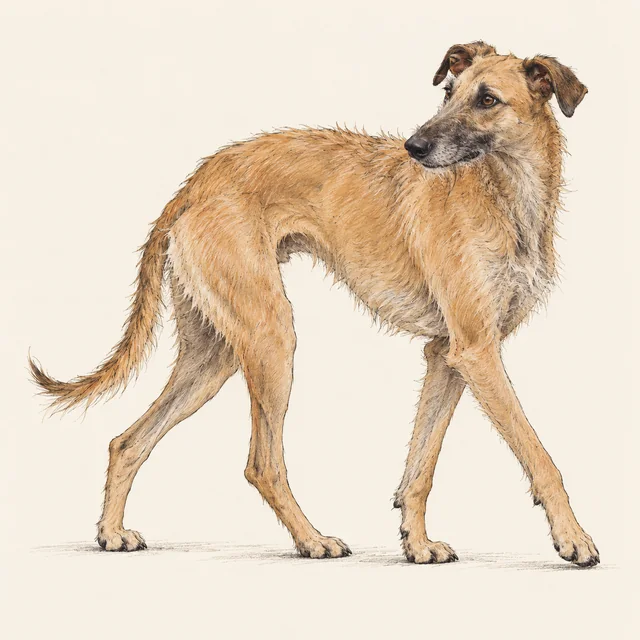
A Lurcher is a type, bringing sighthound ancestry together with other working dogs rather than following one fixed recipe. That variety is part of its appeal: each dog can have its own mix of silhouette, coat and history. For admirers of athletic hounds, meeting a Lurcher means discovering a particular dog rather than ticking off a standardised portrait.
Editorial breed portrait · History and appearance from Purina UK ↗ · checked . Admirer appeal is editorial; individual dogs vary.
Care sources checked · See the evidence
Where you may encounter them
Country context.
United Kingdom: a comparable 2025 registration count is not established here.
United States: no directly matched 2025 AKC ranking is established for this profile.
These are two different registry measures, not counts of all dogs or a global popularity comparison. Other countries and current local availability are unknown here. Registration frequency does not affect matching.
Lifespan entries retain the source’s category or guide range; they are not comparable clinical survival estimates. Exercise guides are not personal prescriptions.
Why explore this option
Potential advantages
The everyday reality
Commitments to consider
- Parentage does not guarantee a particular size, coat or temperament; ask about both parents.Editorial considerationLurcher source ↗
- Plan for a regular daily routine in the publisher’s activity range.Editorial consideration · ActivityLurcher source ↗
- The publisher gives no single answer for coat care, adult size, shedding; treat these as unknown and ask about the individual dog.Editorial considerationLurcher source ↗
Meet the individual
Questions worth asking.
Editorial prompts for a rescue, breeder or professional. Asking a question does not establish a trait or confirm that screening has happened.
- What are the parent breeds, and how big and what coat were each of the parents?
- What activity does this individual need, and what is their history around other dogs and being left alone?
- Which health checks have been completed for the parents?
For a home with children or another dog, discuss observed behaviour, gradual introductions, supervision and separate spaces. Breed alone cannot establish a safe match.
Visible health concerns: RKC Breed Watch
No category stated. We did not find a Breed Watch category for this breed on the Royal Kennel Club pages we read, so we treat it as unknown, not as a good sign.
Breed Watch is the Royal Kennel Club’s system for health concerns it links to a breed’s shape, mainly ones that can be seen in the show ring. It says nothing about inherited disease or how many dogs are affected, and a category describes a breed, not an individual dog. It does not change how breeds are matched here. Ask about both parents’ health tests. Source: Royal Kennel Club — Breed Watch: health and welfare of show dogs ↗, checked 3 October 2026.
Inherited health, screening and allergies
What should you ask about before falling in love with this dog? Published pre-breeding checks provide a starting point: some test inherited conditions, while others assess hips, eyes, breathing or other health concerns. Results are not a guarantee, and this is not a complete disease list.
Establish this dog’s actual ancestry where possible, then ask your vet which health checks fit that background and the individual’s history.
This publisher context is not a comparable registry screening checklist or a measured risk estimate. A cross cannot be assumed to inherit an average of its parents’ risks, or to be healthier because it is a cross.
Source: Purina UK breed context ↗ · United Kingdom · checked . Registry recommendations can change; ask for original results and their interpretation for the actual dog and, where relevant, its parents.
Clinical risk estimates for this profile have not yet been reviewed. Ask about this dog’s history and relevant screening with a vet, rescue or responsible breeder. UK health and screening resources ↗
No dog is 100% hypoallergenic. Coat and shedding information cannot guarantee that an allergic person will tolerate a dog. AAAAI allergy guidance ↗
Costs and next steps
Acquisition and care prices for this breed have not been assessed here. Build a personal budget and explore both adoption and responsible buying.
Plan your next step →Open the field notes
Sources & limitations
Each care entry retains its publisher’s meaning. Open a note to see what was checked and what it cannot tell you.
SizeAmount unknown
Varies; the publisher gives no single size
- Measure
- Publisher size category
- Source context
- Pet-food manufacturer’s breed guide (commercial editorial) · United Kingdom
- Checked
- Publication / data dates
- Not established for this care guidance; the checked date is not a study date.
A broad classification, not an exact adult weight, height or space requirement. A crossbreed can differ from this guide; meet the individual dog.
Read the original size source ↗ActivityPublished guidance
1–2 hours/day, with safe off-lead running several times a week (publisher guide)
- Measure
- Publisher daily activity guide
- Source context
- Pet-food manufacturer’s breed guide (commercial editorial) · United Kingdom
- Checked
- Publication / data dates
- Not established for this care guidance; the checked date is not a study date.
Not an individual exercise prescription. An “up to” category establishes no minimum; age, health and enrichment need a separate assessment. A crossbreed can differ from this guide; meet the individual dog.
Read the original activity source ↗Coat careAmount unknown
Coat varies; no single routine given
- Measure
- Publisher coat-care frequency
- Source context
- Pet-food manufacturer’s breed guide (commercial editorial) · United Kingdom
- Checked
- Publication / data dates
- Not established for this care guidance; the checked date is not a study date.
A broad routine guide, not a complete schedule of brushing, trimming, bathing or professional care. A crossbreed can differ from this guide; meet the individual dog.
Read the original coat care source ↗SheddingAmount unknown
Not stated, or varies
- Measure
- Publisher shedding category
- Source context
- Pet-food manufacturer’s breed guide (commercial editorial) · United Kingdom
- Checked
- Publication / data dates
- Not established for this care guidance; the checked date is not a study date.
Not a measured amount of hair and not evidence of human allergy tolerance. Unknown or variable shedding receives no favourable score. A crossbreed can differ from this guide; meet the individual dog.
Read the original shedding source ↗Lifespan guidancePublished guidance
13–15 years (publisher guide range)
- Measure
- Publisher lifespan guidance
- Source context
- Pet-food manufacturer’s breed guide (commercial editorial) · United Kingdom
- Checked
- Publication / data dates
- Not established for this care guidance; the checked date is not a study date.
Registry thresholds and editorial ranges are not comparable survival statistics. No study dates, sample or survival method are established here. A crossbreed can differ from this guide; meet the individual dog.
Read the original lifespan guidance source ↗- Purina UK — Lurcher ↗Pet-food manufacturer’s breed guide (commercial editorial) · United Kingdom · Checked 2026-10-03
A pet-food manufacturer’s breed guide, not a clinical study or a registry standard. Each page’s summary list and body text can disagree; the body text is used, and a fact is recorded as unknown where they conflict materially. A crossbreed can differ widely from the guide; where the page says a trait is hard to predict or gives no usable statement it is recorded as unknown. The page’s star ratings and family-suitability statements are not adopted, and no health, safety or allergy assurances are taken from it.'
Sources may use broad categories. Editorial advantages and commitments interpret these facts; they are not compatibility probabilities. The source tables and editorial mapping were independently checked by another AI agent; this is not veterinary or expert review. Read our method