
Guide · UK sources · checked 9 November 2026
Grooming and coat care at home.
Coat care is one of the big everyday commitments in the breed comparison. This guide covers the basics that apply to any coat.
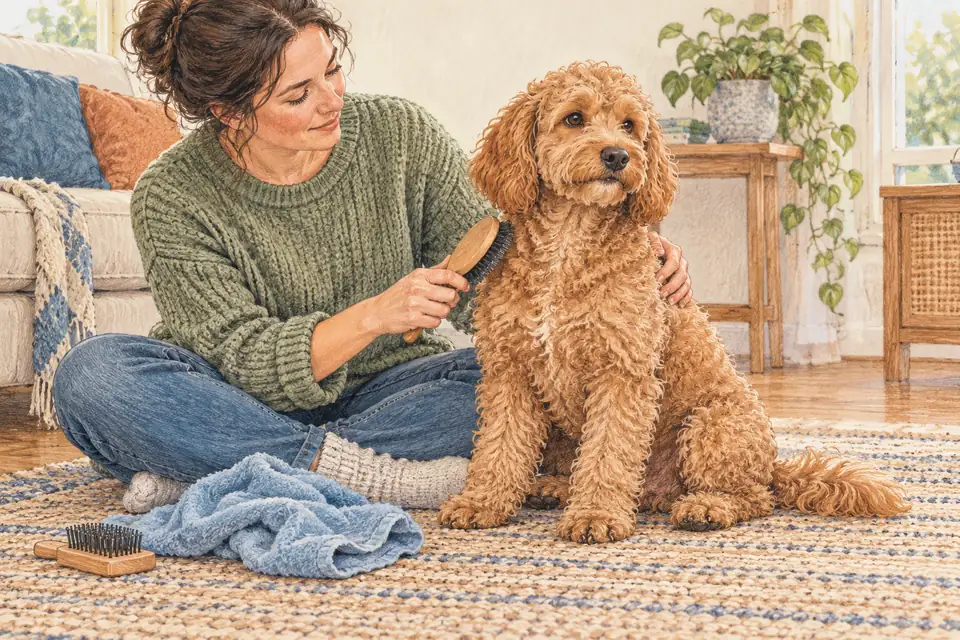
How often to brush
The Royal Kennel Club says short coats need light brushing two or three times a week, while medium and long coats may need daily brushing to prevent mats. PDSA gives similar ranges (long coats daily, medium coats several times a week, short coats weekly) and says to brush more in spring and autumn shedding seasons. PDSA says curly coats are more prone to knotting and suggests brushing a few times a week. Our breed profiles show each breed’s own coat-care category; use those with these ranges.
PDSA says curly coats are more prone to knotting and tangling, and some owners have them clipped shorter. Our editorial view: a coat that drops less hair is not necessarily less work. Low shedding is also not an allergy rating: see dog allergies and “hypoallergenic” breeds. For breeds whose care listing is once a week, see breeds with weekly coat care.
Double coats: brush, do not shave
Many working and northern breeds have a double coat: a dense undercoat beneath longer guard hairs. It can look as if shaving would keep such a dog cool, but the sources say otherwise. The USPCA’s grooming salon does not recommend shaving double-coated dogs, giving reasons that include the undercoat’s role in regulating temperature, sunburn and heatstroke risk, skin irritation, and a top coat that can take up to two years to grow back. The American Kennel Club says shaving can make a double-coated dog hotter, removes protection from the sun, and can leave the coat growing back patchy or with a different texture. Regular brushing through the shedding seasons is the usual alternative. Where a coat has to come off for a health reason, such as severe matting, the USPCA agrees it with the owner and possibly the vet first.
Bathing, nails and teeth
- Bathe only when needed, with a dog-specific shampoo; frequent bathing can cause skin problems (Royal Kennel Club).
- Dogs with skin folds need the folds cleaned and dried daily (Royal Kennel Club).
- The Royal Kennel Club says to trim nails when they touch the ground and to check dew claws. PDSA says to use clippers made for dogs and cut a few millimetres away from the quick, the sensitive part with a blood supply; for dark nails or if you are unsure, ask your vet to show you.
- Teeth: PDSA and Blue Cross both suggest brushing daily, with a dog toothpaste. Blue Cross says not to use human toothpaste, which can contain chemicals that are toxic to dogs, and that dental chews and similar products can help but do not replace brushing. Introduce it slowly: Blue Cross suggests starting with stroking the cheek and letting the dog lick toothpaste from your finger, and says most dogs accept a brush within a couple of weeks. Red, swollen or bleeding gums, bad breath, reluctance to eat or pawing at the mouth are reasons to see your vet.
Starting well
The Royal Kennel Club advises handling a puppy’s mouth, eyes and paws early so grooming feels familiar, and suggests using a professional groomer at first to learn the right routine for the coat. PDSA advises leaving matted fur to a professional, checking the skin for parasites while you groom, and choosing a groomer who belongs to a trade body such as the Pet Industry Federation.
Shopping for a brush or comb
Ad: If you buy through these links, ChooseMyDoggy earns a commission.
Brushes and combs are widely sold, and you do not need to buy through these links. These links go to Christies Direct, a grooming equipment retailer, and open in a new tab.
Sources
- Royal Kennel Club, how to groom my dog ↗
- PDSA, how often should you groom your pet? ↗
- PDSA, how to clip your dog’s nails ↗
- Blue Cross, dog dental care (reviewed 3 October 2024) ↗
- USPCA Groom Room, grooming policies (double coats and matting) ↗
- American Kennel Club, is it OK to shave your dog? (updated 27 March 2026, United States) ↗
Limits: general guidance; individual coats vary. The USPCA source is one grooming salon’s policy and the American Kennel Club is a US source; they agree on double coats but are not veterinary studies. No product or groomer is recommended and nothing here changes breed matching.
Every breed profile’s “Care at a glance” panel shows the publisher’s coat-care and shedding guidance, with links to the sources. Browse all 259 breed profiles, or put two to four breeds side by side in Compare.