
Crossbreed · Source-checked care guide
Goldador.
Behind the Goldador are Lord Tweedmouth's yellow retrievers and the Labrador's Newfoundland fishing-dog ancestors. These are two distinct routes into the retriever family. Their working histories give the portrait depth, while meeting the individual tells you more than imagining a guaranteed blend of parental qualities.
Editorial opening portrait · checked . Admirer appeal is editorial; individual dogs vary.
Opening portrait sources (2)
These accounts describe the parent breeds. They do not establish a standard, care needs or temperament for this cross.
- Royal Kennel Club breed history: Golden Retriever ↗ · Registry history · UK registry account of a parent breed · checked .
- Royal Kennel Club breed history: Labrador Retriever ↗ · Registry history · UK registry account of a parent breed · checked .
History and appearance follow the linked accounts, which may retain uncertain origins or traditional stories. Admirer appeal is not an owner survey, and this portrait supplies no matching inputs.
Care sources checked · See the evidence
Related guides
Care at a glance
Publisher care guidance to explore, not a prediction about an individual dog.
Lifespan entries retain the source’s category or guide range; they are not comparable clinical survival estimates. Exercise guides are not personal prescriptions.
Beyond the facts
A little more of the story.
The Goldador brings together two retrievers with well-documented roots. The Golden Retriever traces back to the first Lord Tweedmouth, who crossed a yellow Wavy Coated Retriever with a Tweed Water Spaniel and got four yellow puppies; the breed was recognised as the "yellow" or "golden" Retriever in 1913. The Labrador descends from dogs that helped Newfoundland fishermen, and its versatility has made it a guide dog and service dog as well as a gundog.
Unlike most crosses, this one has a clear modern purpose. Britain's Guide Dogs charity breeds Labrador and Golden Retriever crosses deliberately, aiming to combine the best of both, and describes them as its most successful guide dog of all. More than 60% of its working guide dogs are this cross. The charity values the Labrador's sociable, food-motivated eagerness to please, which suits reward-based training, alongside the Golden's intelligent, gentle nature.
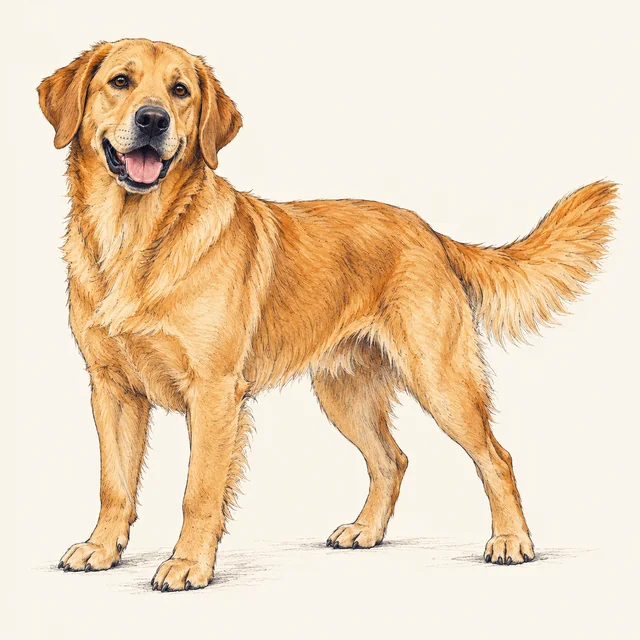
Even within a planned programme, appearance varies a great deal: these are large, muscular dogs with floppy ears, and coats can differ in length and thickness and come in yellow, white or black. As with any cross, character varies between individuals, so meet the actual dog.
Editorial portrait drawing on the sources below. History and appearance do not predict an individual dog’s character.
- Guide Dogs: our crossbreeds ↗ · Charity guidance · UK charity account · checked .
- Royal Kennel Club breed history: Golden Retriever ↗ · also listed under “Opening portrait sources” above · checked .
- Royal Kennel Club breed history: Labrador Retriever ↗ · also listed under “Opening portrait sources” above · checked .
Where you may encounter them
Country context.
United Kingdom: a comparable 2025 registration count is not established here.
United States: no directly matched 2025 AKC ranking is established for this profile.
These are two different registry measures, not counts of all dogs or a global popularity comparison. Other countries and current local availability are unknown here. Registration frequency does not affect matching.
Why explore this option
Potential advantages
The published care categories do not point to an everyday advantage for this breed. That is not a verdict: temperament, purpose and the individual dog matter more, and the questions below are the place to start.
The everyday reality
Commitments to consider
- Parentage does not guarantee a particular size, coat or temperament; ask about both parents.Editorial considerationGoldador source ↗
- Plan for adult size, including space, transport, feeding and veterinary costs.Editorial consideration · Sizeour breeds: crossbreeds source ↗
- Account for shedding.Editorial consideration · SheddingGoldador source ↗
- The sources give no single answer for activity needs, coat care; treat these as unknown and ask about the individual dog.Editorial considerationGoldador source ↗
Meet the individual
Questions worth asking.
Editorial prompts for a rescue, breeder or professional. Asking a question does not establish a trait or confirm that screening has happened.
- What are the parent breeds, and how big and what coat were each of the parents?
- What activity does this individual need, and what is their history around other dogs and being left alone?
- Which health checks have been completed for the parents?
For a home with children or another dog, discuss observed behaviour, gradual introductions, supervision and separate spaces. Breed alone cannot establish a safe match.
Visible health concerns: RKC Breed Watch
No category stated. We did not find a Breed Watch category for this breed on the Royal Kennel Club pages we read, so we treat it as unknown, not as a good sign.
Breed Watch is the Royal Kennel Club’s system for health concerns it links to a breed’s shape, mainly ones that can be seen in the show ring. It says nothing about inherited disease or how many dogs are affected, and a category describes a breed, not an individual dog. It does not change how breeds are matched here. Source: Royal Kennel Club — Breed Watch: health and welfare of show dogs ↗, checked 3 October 2026.
Inherited health, screening and allergies
What should you ask about before falling in love with this dog? Published pre-breeding checks are a starting point: some test for inherited conditions, others assess hips, eyes, breathing or other concerns. Results are not a guarantee, and this is not a complete disease list.
Ask for the Labrador Retriever and Golden Retriever parents’ health records, and discuss the relevant checks with your vet.
This publisher context is not a comparable registry screening checklist or a measured risk estimate. A cross cannot be assumed to inherit an average of its parents’ risks, or to be healthier because it is a cross.
Source: Purina UK breed context ↗ · United Kingdom · checked . Registry recommendations can change; ask for original results and their interpretation for the actual dog and, where relevant, its parents.
Clinical risk estimates for this profile have not yet been reviewed; discuss this dog’s history and screening with a vet, rescue or responsible breeder. UK health and screening resources ↗
No dog is 100% hypoallergenic. Coat and shedding information cannot guarantee that an allergic person will tolerate a dog. AAAAI allergy guidance ↗
Could a Goldador fit your life?
Check the Goldador against your own weekday routine, home and coat-care time. Your answers stay on your device.
Check Goldador in Your Doggy Match →
Compare side by side with Goldendoodle and Labradoodle →
Other crossbreeds
From the same breed group, in alphabetical order; not a ranking or recommendation.
UK · reference floor, not a quote · checked 17 October 2026
What Goldador care might cost.
These are UK charity estimates for a dog of a similar size, not prices for Goldador specifically. Our “large” category is shown against PDSA’s large-breed estimate.
- Getting started (minimum)
- £560
- Each month (minimum)
- £116
- Each year (our arithmetic: monthly × 12)
- £1,392
- PDSA size-band lifetime minimum
- £8,200 to £18,800
The lifetime estimate uses PDSA’s size-group life-expectancy assumptions, not this breed’s recorded lifespan.
Source: PDSA, the cost of owning a dog ↗. Minimum costs, calculated in 2024 from online product prices; the page shows no update date and does not define its size bands. Excludes the dog’s price, microchipping and vet fees for illness or injury. Because PDSA does not define its size bands, any match between a breed and a band is editorial.
A second view. Battersea says it typically costs £1,800 to £2,000 a year to care for a dog, which is higher than the minimum above. Battersea gives no size or breed breakdown for that figure, so the difference may reflect different assumptions; neither source is a quote. Battersea source ↗
What is not here. The price or adoption fee, vet bills for illness or injury, insurance premiums for this breed, training, boarding and breed-specific health costs. We have no source for a breed-specific cost, so none is given. How the figures compare →
Open the field notes
Sources & limitations
Each care entry retains its publisher’s meaning. Open a note to see what was checked and what it cannot tell you. A note with no publication or data date line has none established for that guidance. Checked dates are not study dates.
These points apply to several notes and sources below:
- Entries cross-checked against independent commercial guides on 14 October 2026 state in their label whether the guides agree or differ; where they differ, no single value is encoded. No charity, registry or study source was found for them.
- A crossbreed can differ from these guides; meet the individual dog.
- Each commercial guide is a business with a sales interest, not a charity, registry or study; its figures may repeat other sites’ and are not a measured survey.
SizePublished guidance
Large (Guide Dogs, working-dog programme)
- Measure
- Publisher size category
- Source context
- UK animal-welfare charity breed guidance (non-commercial) · United Kingdom
- Checked
Guide Dogs says of the Labrador Retriever x Golden Retriever cross: “They’re known to be large in size”. This replaces the Purina UK size for the same value. The dogs are from a charity’s selected working-dog breeding programme, not the pet population, and the page gives no weight. It also says “Their coat can vary in length and thickness”.
Read the original size source ↗ActivityAmount unknown
Guides differ: Purina UK two hours or more, Basepaws 60–90 minutes, Paction 45–60; no activity band is encoded (commercial guides differ; no charity or study)
- Measure
- Daily activity time stated by independent commercial guides
- Source context
- US pet-DNA company breed guide (commercial) · United States
- Checked
Sources: Basepaws, Paction, The Labrador Site, with the Purina UK page cited alongside (two hours or more/day (its page summary says 1–2 hours)). The sources span 45 minutes to two hours or more, which crosses our activity bands, so the field is unknown rather than a pick. The Labrador Site says only “take your dog on daily walks”. Basepaws’ own care box says “30-45 minutes daily” against “60–90 minutes” in its text; the box matches its Shorkie page word for word, so it looks like a template error. Not an individual exercise prescription. An “up to” category establishes no minimum; age, health and enrichment need a separate assessment.
Read the original activity source ↗Also cited for this entry:
Coat careAmount unknown
Coat varies; no single routine given
- Measure
- Publisher coat-care frequency
- Source context
- Pet-food manufacturer’s breed guide (commercial editorial) · United Kingdom
- Checked
A broad routine guide, not a complete schedule of brushing, trimming, bathing or professional care.
Read the original coat care source ↗SheddingPublished guidance
Sheds (Purina UK, commercial single source)
- Measure
- Publisher shedding category
- Source context
- Pet-food manufacturer’s breed guide (commercial editorial) · United Kingdom
- Checked
Not a measured amount of hair and not evidence of human allergy tolerance. Unknown or variable shedding receives no favourable score. Single commercial source: Purina UK is the only source for this field, and no non-commercial source for it was found when checked on 13 October 2026; read it as one publisher’s view.
Read the original shedding source ↗Lifespan guidancePublished guidance
10–12 years (several commercial guides agree; no charity or study)
- Measure
- Lifespan range stated by independent commercial guides
- Source context
- US pet-DNA company breed guide (commercial) · United States
- Checked
Sources: Basepaws, The Labrador Site, Paction, with the Purina UK page cited alongside (unknown). Basepaws, The Labrador Site and Paction all give 10–12 years. Hepper (fetched only, re-read pending) gives the same range and was not used. Guidance, not a survival estimate. Registry thresholds and editorial ranges are not comparable survival statistics. No study dates, sample or survival method are established here.
Read the original lifespan guidance source ↗Also cited for this entry:
- Purina UK — Goldador ↗Pet-food manufacturer’s breed guide (commercial editorial) · United Kingdom · Checked 2026-10-03
A pet-food manufacturer’s breed guide, not a clinical study or a registry standard. Each page’s summary list and body text can disagree; the body text is used, and a fact is recorded as unknown where they conflict materially. A crossbreed can differ widely from the guide; where the page says a trait is hard to predict or gives no usable statement it is recorded as unknown. The page’s star ratings and family-suitability statements are not adopted, and no health, safety or allergy assurances are taken from it. On 13 October 2026 these fields were replaced or relabelled using non-commercial sources where those conflicted with or covered this page: size. On 14 October 2026 these fields were compared with independent commercial guides (no charity or study exists for them) and are now sourced to those pages, with this page cited alongside: exercise, lifespan. Where the guides disagreed with each other or with this page, the field is unknown or a range, not a pick. Any field not listed stays on this single commercial page unless stated. - Guide Dogs — our breeds: crossbreeds ↗UK animal-welfare charity breed guidance (non-commercial) · United Kingdom · Checked 2026-10-13
Describes dogs in a charity’s selected working-dog breeding programme, which is not the pet population. No publication date is shown. It gives no exercise, grooming-frequency, shedding amount or lifespan figure, and says no breed is truly hypoallergenic. - Basepaws — Goldador ↗US pet-DNA company breed guide (commercial) · United States · Checked 2026-10-14
Page shows: no date shown. Wording used for the Goldador (checked 14 October 2026), quoted from the page: Activity: “about 60–90 minutes of daily exercise”; Lifespan: “10–12 years”. - Paction — Goldador ↗Canadian breeder-certification and puppy platform breed guide (commercial) · Canada · Checked 2026-10-14
Page shows: no date shown. Wording used for the Goldador (checked 14 October 2026), quoted from the page: Activity: “About 45 to 60 minutes of daily exercise”; Lifespan: “10-12 yrs”. - The Labrador Site — Goldador ↗Breed-information website (commercial) · Unclear (US-written page; the site belongs to the Dogsnet family) · Checked 2026-10-14
Page shows: Updated on August 21, 2025. Wording used for the Goldador (checked 14 October 2026), quoted from the page: Activity: “take your dog on daily walks”; Lifespan: “averages 10 to 12 years”.
Editorial advantages and commitments interpret these facts; they are not compatibility probabilities. The source tables and editorial mapping were independently checked by another AI agent; this is not veterinary or expert review. Read our method